

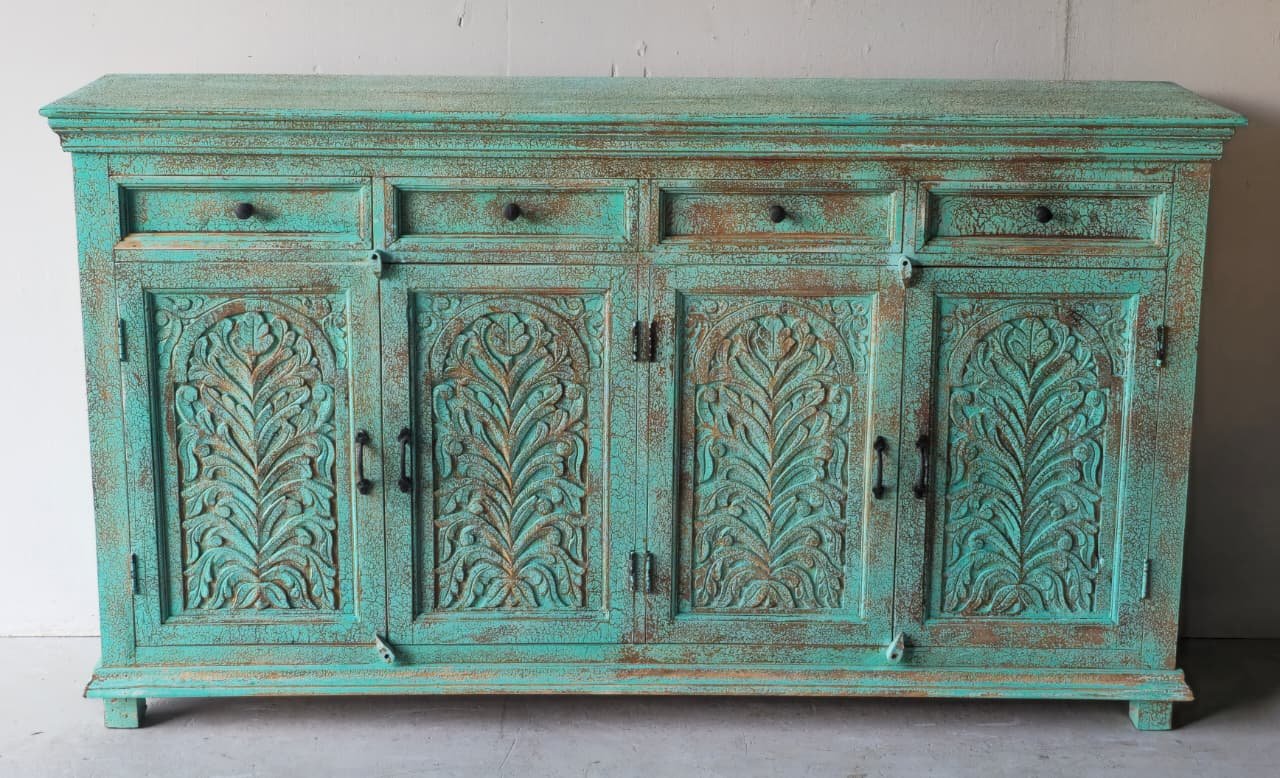
On the numbers, sheesham is the hardest of the four (1,660 lbf Janka), teak and mango are effectively tied for hardness (both around 1,070 lbf), and teak is the most dimensionally stable and the most decay- and termite-resistant. But hardness is the least useful number here. What determines whether a piece survives twenty years in an Indian home is movement, moisture and where it sits in the room.
It’s a familiar case in furniture workshops: a sheesham dining table, six seats, carved apron, brought in for a look after eleven years in a home in Gurugram.
The top had cupped. Not dramatically — you could rock a glass on it, that was all. But the interesting part was where. The two boards nearest the window had moved; the rest of the top was flat. Eleven years of Delhi cycling from 15% relative humidity in May to 80% in August, with one edge of the table getting direct afternoon sun through glass, and the wood had done exactly what wood does.
Nobody had done anything wrong. The joinery was sound, the finish was intact, the timber was good. The table had simply been put somewhere that asked more of it than the species could give.
That is the thing every “best wood for furniture” guide leaves out. There is no best wood. There is a wood that suits a species of use, in a climate, at a price — and four woods that all fail in different, predictable, entirely avoidable ways.
The numbers, in one table
These are published figures from the Wood Database, which reports standardised measurements rather than marketing claims. Price bands are indicative Indian retail ranges for furniture-grade sawn timber and vary enormously by grade, origin and season — treat them as ratios, not quotations.
| Teak (Tectona grandis) | Sheesham (Dalbergia sissoo) | Mango (Mangifera indica) | Mahogany (Swietenia macrophylla) | |
|---|---|---|---|---|
| Janka hardness | 1,070 lbf (4,740 N) | 1,660 lbf (7,380 N) | 1,070 lbf (4,780 N) | ~800 lbf (3,570 N) |
| Dried weight | 40.9 lb/ft³ (655 kg/m³) | 48 lb/ft³ (770 kg/m³) | 42.1 lb/ft³ (675 kg/m³) | ~37 lb/ft³ (590 kg/m³) |
| Radial shrinkage | 2.6% | 3.1% | 3.6% | 3.0% |
| Tangential shrinkage | 5.3% | 5.3% | 5.5% | 4.1% |
| Volumetric shrinkage | 7.2% | 8.4% | 8.9% | 7.8% |
| T/R ratio (lower = more stable) | 2.0 | 1.8 | 1.5 | 1.4 |
| Decay resistance | Very durable | Durable to very durable | Moderately durable to perishable | Moderately durable |
| Termite resistance | Resistant | Not specifically rated | Susceptible | Moderate |
| Insect risk | Moderate to powder-post beetle | Low–moderate | High — powder-post beetle and termite above 12% MC | Moderate |
| Tool wear | High — up to 1.4% silica | Moderate — chalky deposits | High — silica content | Low |
| Relative cost | Highest of the four | Moderate | Lowest | High, and legally complicated |
Two things in that table are counter-intuitive enough to be worth saying out loud.
Sheesham is substantially harder than teak. Roughly 55% harder on the Janka scale. If someone tells you teak is chosen because it is the hardest, they have not looked it up.
Mango’s dimensional numbers are actually good. A T/R ratio of 1.5 is better than teak’s 2.0, meaning mango moves more evenly across its two axes and is less prone to cupping. Mango’s problem is not stability. It is biology.
Where each one lets you down
This is the section every competitor page omits, which is exactly why it belongs high up.
Teak
The failure mode: your wallet, and your supply chain.
Teak’s technical reputation is deserved. It is very durable, termite-resistant, dimensionally the most predictable of the group in service, and its natural oils make it forgiving of neglect. There is a reason it was the default for colonial-era furniture, boat decks and railway carriages.
The problems are commercial. First, price — teak sits at a multiple of the others, and that multiple has been rising for decades. Second, and more seriously, “teak” is the most abused word in Indian furniture retail. Burma teak, plantation teak from Nagpur or Ghana, and “teak finish” on rubberwood are three completely different products sold with overlapping vocabulary. Old-growth Burma teak and fast-grown plantation teak differ substantially in density, oil content and ring spacing, and both are legitimately “teak.”
Third: the silica content that blunts tools also means teak carving costs more in labour and consumables than the same carving in sheesham.
Ask: where the teak was grown, how old the trees were, and whether it is plantation or natural forest. If nobody can answer, you are buying a word.
Sheesham
The failure mode: movement in a dry-to-humid climate swing.
Sheesham is the workhorse of North Indian furniture for good reasons: hard, dense, decay-resistant, machines and carves beautifully, takes a finish well, and grows in the region so the supply chain is short. Its interlocked grain gives it the ribbon figure people like.
But sheesham has a tangential shrinkage of 5.3% and a habit of being sold before it is properly dry. The failure I described at the top of this article is the classic one: wide boards, a big seasonal humidity swing, and one edge of the piece exposed to a different microclimate than the rest. It cups, it develops hairline checks at end grain, and panels in frames can shrink enough to expose an unfinished line at the edge.
That interlocked grain also tears out during surfacing, which is a manufacturing issue rather than an owner’s problem — but it is why cheap sheesham furniture often has filled patches under the finish.
Ask: what moisture content the timber was dried to, and whether it was kiln-dried or air-dried. For most of India, furniture timber should be at 8–12% depending on region. “Seasoned” is not an answer; it is a mood.
Mango
The failure mode: insects, and softness at the edges.
Mango deserves better than its reputation and worse than its marketing. It is genuinely a hardwood, its Janka hardness matches teak’s, its dimensional behaviour is good, and its sustainability story is real rather than invented — the Wood Database notes that mango plantations commonly harvest trees for lumber after their fruit-bearing life ends, so the timber is a by-product of an existing agricultural cycle rather than a reason to fell a forest.
Its two real weaknesses:
Insects. Mango is rated moderately durable to perishable and is susceptible to both fungal and insect attack. It is particularly vulnerable to powder-post beetle and termite when moisture content exceeds 12%. Kiln drying kills existing infestation, and interior-use mango should be dried to 8% or below. Un-kiln-dried mango furniture is a genuine risk, not a theoretical one — this is the single most important fact in this entire article for anyone buying at the budget end.
Edge wear. Despite the Janka figure, mango dents at exposed edges and corners more readily than sheesham in practice, partly because of the spalted and variable-density sections that give it its colour. On a coffee table it is fine. On the front edge of a heavily used dining table with children in the house, it is a compromise.
Ask: was it kiln-dried, and to what moisture content? For mango this question is not optional.
Mahogany
The failure mode: legality, and the fact that it is probably not mahogany.
Genuine Swietenia macrophylla — big-leaf or Honduran mahogany — is a Central and South American timber, listed on CITES Appendix II, which means international trade requires export permits and legal-origin documentation. It is a legitimate trade, but it is a regulated one.
Very little furniture sold as “mahogany” in India is Swietenia macrophylla. The name is routinely applied to African species (khaya, sapele), to Indian-grown Swietenia plantation timber, and — most often — to a reddish stain on something else entirely.
On its technical merits real mahogany is excellent: stable (T/R ratio 1.4, the best of this group), easy to work, kind to tools, and beautiful. It is also softer than the other three at around 800 lbf, and only moderately decay-resistant.
Ask: the botanical name, and for CITES documentation if it is claimed as Swietenia macrophylla of American origin. A seller who cannot produce either is not necessarily dishonest — they may have bought it under the same loose name — but you are not buying what the label says.
Which one for which job
| Use | Best choice | Why | Avoid |
|---|---|---|---|
| Dining table, heavy daily use, children | Sheesham or teak | Edge hardness and dent resistance matter most | Mango at exposed edges |
| Bed frame | Any of the four | Low wear, mostly static load | Under-dried anything |
| Outdoor or verandah | Teak, and only teak | The only one of the four with real weather and termite resistance | Mango outright |
| Coastal humidity (Chennai, Kochi, Goa, Mumbai) | Teak | Highest decay and dimensional resistance in sustained high RH | Mango — fungal risk |
| Delhi / Jaipur / Lucknow dry-to-monsoon swing | Teak, then sheesham with wide panels avoided | Big seasonal RH swing punishes tangential movement | Wide single-board sheesham tops |
| Heavily carved statement pieces | Sheesham | Carves crisply, holds fine detail, hardness protects the detail | Mango — soft detail crumbles |
| Budget-conscious, low-wear pieces | Mango, kiln-dried | Genuine hardwood at the lowest price of the four | Mango that has not been kiln-dried |
| Fine cabinetry, veneered work | Mahogany | Most stable, kindest to tools, finest surface | Any of the above if tool wear is a cost driver |
The questions that matter more than species
After twenty years, three things predict whether a piece of furniture is still good, and species is not the first of them.
1. Moisture content at the time of manufacture. This is the dominant variable. Furniture built from timber at 18% moisture will move as it dries to equilibrium in a conditioned room, regardless of how noble the species is. Teak at 18% will fail faster than mango at 8%.
2. How the piece is engineered to move. Wood moves across the grain and effectively not along it. Good construction anticipates this: floating panels in frames, tabletops fastened with buttons or slotted screws that allow lateral movement, breadboard ends that are pinned rather than glued along their length. A tabletop glued rigidly to an apron will crack, in any species, in any climate.
3. Where you put it. The Gurugram table failed because of a window. Direct sun through glass creates a moisture and temperature gradient across a single board that no species tolerates indefinitely. Neither does a piece sitting against an external wall that gets monsoon damp, or above a floor-level AC outlet.
If you take one thing from this article, take this: ask about moisture content before you ask about species.
What to ask your own workshop
Rajasthan’s carving tradition — the vocabulary of deep relief, jaali and undercut work you see across North Indian furniture — developed around sheesham specifically, because the wood’s hardness holds fine detail without crumbling. Wasim Ahmad, who has worked in Jaipur for four decades and whose woodwork is in the interiors of the Palace on Wheels, describes choosing the wood before drawing the design and letting the grain set the direction — something only possible when a workshop is selecting boards individually rather than buying to a spec sheet.
That is the standard worth holding any workshop to, including ours: ask which species they use for which product category, what moisture content the timber is dried to, whether it is kiln- or air-dried, how long it was seasoned, and where it was sourced. A workshop that selects boards individually, the way Wasim Ahmad does, should be able to answer all five without hesitating. If a seller cannot, that tells you something about how the piece was actually made — regardless of how good the finished object looks in a showroom. Read more about the tradition his workshop carries forward.
The Folklorei view
Every brand tells you their wood is the best. The more useful claim is smaller: each of these four species will fail, and each fails in a way you can predict and design around.
Teak fails your budget. Sheesham fails in a bad humidity swing on a wide unrestrained panel. Mango fails to insects if it was not dried properly. Mahogany fails to be mahogany. Knowing the failure mode is worth more than knowing the sales pitch, because the failure mode tells you where to put the piece, what to ask before you buy it, and what to check in year three.
That Gurugram table, in a case like this, usually turns out fine. Two boards taken off, re-flattened, refitted with slotted fixings so the top can move against the apron, and it goes back into service. Eleven years of a house’s life, one afternoon of correction. That is not a wood failing. That is a wood behaving exactly as documented, in a position nobody had thought about.
Think about the position.
Frequently asked questions
Which is better, sheesham or teak?
They are better at different things. Sheesham is considerably harder — 1,660 lbf against teak’s 1,070 lbf on the Janka scale — so it resists denting better and holds carved detail more crisply. Teak is more decay-resistant, termite-resistant, more forgiving of neglect and the only one of the two genuinely suitable for outdoor or verandah use. Teak also costs substantially more.
Is mango wood a real hardwood?
Yes. Mango is a botanical hardwood and its Janka hardness of 1,070 lbf is essentially identical to teak’s. Its weaknesses are biological rather than structural: it is rated moderately durable to perishable and is susceptible to powder-post beetle and termite attack when moisture content is above 12%.
Does sheesham crack in Delhi?
It can, and the mechanism is well understood. Delhi’s relative humidity swings from very dry in May to very humid in August. Sheesham has a tangential shrinkage of 5.3%, so wide unrestrained panels move measurably across that cycle. The risk is highest with wide single boards, rigidly fixed tops, and pieces placed in direct sun through glass. Properly dried timber and construction that allows movement largely solve it.
Is teak worth the price difference?
For outdoor use, coastal humidity or anywhere with termite pressure, yes — it is the only one of these four with genuine weather and insect resistance. For an indoor piece in a dry climate, the premium buys durability you may never call on, and sheesham at half the price is a defensible choice. The bigger risk is paying teak prices for plantation teak or teak-finished rubberwood.
Is mango wood good for furniture?
Yes, if it has been kiln-dried to 8% moisture or below. Kiln drying kills existing insect infestation and brings the timber to a stable interior moisture level. Mango’s dimensional stability is actually better than teak’s on the T/R ratio, and its sustainability case is real, since it is typically harvested from plantations at the end of fruit-bearing life. Un-kiln-dried mango is a genuine insect risk.
What moisture content should furniture timber be at in India?
Broadly 8–12%, varying by region — lower for dry northern interiors with air conditioning, higher for coastal areas. The important thing is that the timber was dried to equilibrium for the environment the furniture will live in, not simply “seasoned.”
Is mahogany legal to buy in India?
Big-leaf mahogany (Swietenia macrophylla) is listed on CITES Appendix II, so international trade requires permits and legal-origin documentation. It is legal to trade with the correct paperwork. In practice, most Indian furniture sold as “mahogany” is a different species or simply a stain, so the first question is botanical identity rather than legality.
What wood is best for carved furniture?
Sheesham, in Indian practice. Its hardness holds fine detail without crumbling, it carves crisply, and the north Indian carving tradition developed around its behaviour. Teak carves well but its silica content blunts tools rapidly, adding labour cost. Mango is too soft at fine detail for heavily carved work.