

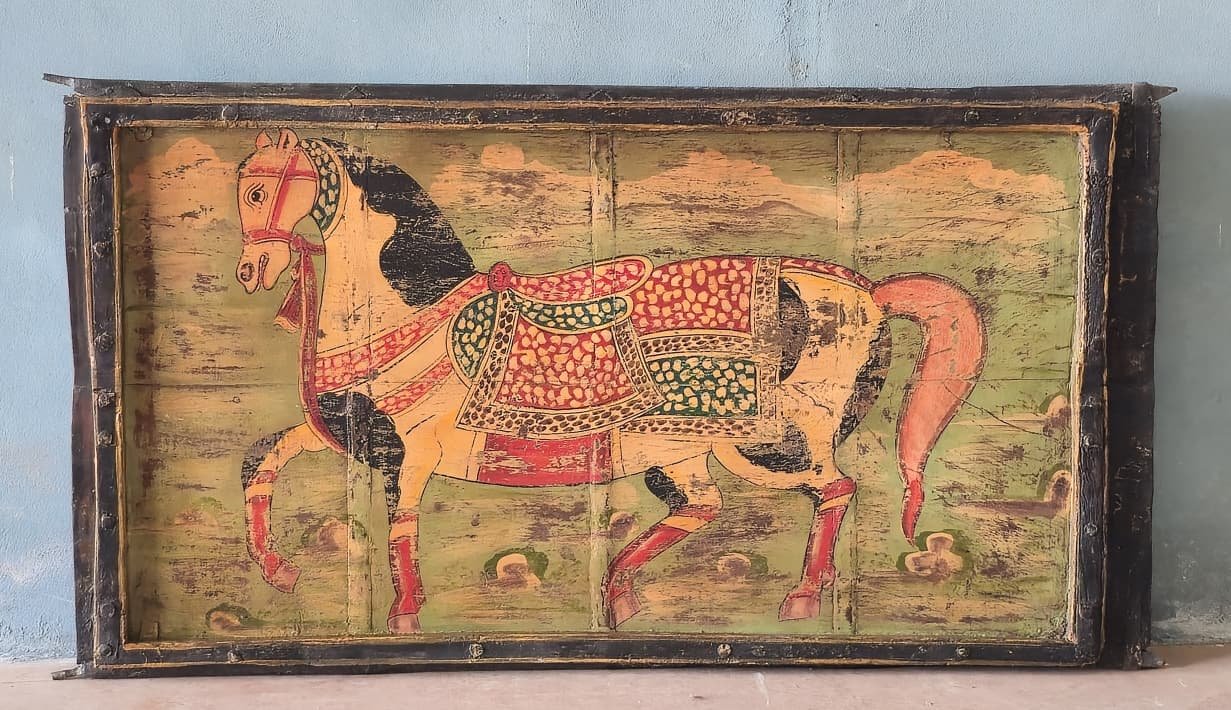
Ornament did not disappear because people stopped liking it. It disappeared because the economics that produced it — cheap, often coerced, structurally underpaid labour — stopped being available, and because the twentieth century built an aesthetic argument on top of that economic fact. Both things are true at once, and any defence of craftsmanship that ignores the second one deserves to lose.
A porcelain cup with a hand-painted rim sat beside a plain white mug in a photograph online. The caption implied the obvious thing: look what we traded away.
The post collected tens of thousands of likes. It also collected this, near the top of the comments:
“That tea cup looks like a nightmare to wash. Certain beauty is just not worth the maintenance.”
And, under a companion post about ornamented Victorian lampposts against modern street infrastructure:
“All those buildings were built by exploited people.”
And:
“Old world is luxurious — not every millionaire can own that.”
Between two posts, roughly 136,000 likes and something close to 8,700 comments, and the three objections above turned up again and again in different phrasings. They are not trolling. They are the argument, and they are largely correct.
So this is not going to be a piece about how everything used to be better. Everything did not used to be better. This is about what survives once you concede all three.
Concession one: it was built by people who were not paid properly
The ornament of the pre-industrial world was affordable because labour was cheap in ways that are now illegal, and in many cases was not freely given at all.
Guild apprenticeships that ran a decade with minimal compensation. Hereditary occupational systems that assigned a person’s work at birth. Bonded labour. Workshops organised around family labour that was never counted as labour. In the Indian context, craft production was structurally tied to caste and to patronage relationships that were not entered into freely. In the European context, the cathedral and the country house were built on arrangements that any modern labour inspectorate would shut down inside a day.
That is why a nineteenth-century lamppost could carry that much cast ornament and still be affordable municipal infrastructure. Not because we were wiser about beauty. Because the foundry hands were cheap.
And the striking thing is that this has not fully ended. India’s handicraft and handloom sector employs some 11.3 million people, and the Institute for Human Development and Crafts Council of India study published in May 2026 found average earnings of about ₹270 per day — below the statutory minimum wage in every state surveyed. Annual value added per worker ran as low as ₹44,000 in Uttar Pradesh, under ₹3,700 a month.
So when someone says ornament was built by exploited people, the accurate response is not “that was a long time ago.” It is: in significant part, it still is. Anyone selling handmade objects who has not looked at that number has not done the reading.
Concession two: it was only ever available to a few
The buildings that get photographed for these comparisons are the surviving ones, and the surviving ones are disproportionately the expensive ones.
The carved haveli survived because it was built well and belonged to someone with money. The tenement across the lane did not survive and is not in the photograph. What we are comparing when we set a nineteenth-century façade against a modern one is usually a merchant’s house against ordinary contemporary housing — and the honest version of that comparison would put the merchant’s house against a modern penthouse, where quite a lot of ornament is still being commissioned.
Survivorship bias is doing enormous work in every one of these posts. The past looks more beautiful than it was because ugly things get demolished first.
Concession three: it was genuinely a burden
The maintenance objection is the one most often dismissed as philistinism, and it is the most reasonable of the three.
Ornament collects dust. Carving collects it in places a cloth cannot reach. Marble etches. Brass tarnishes. Textiles need airing. A hand-painted rim cannot go in a dishwasher, and the person who has to hand-wash it is, historically and often still, a woman or a servant whose time the object’s owner was not counting.
That is worth saying plainly: a great deal of the “effortless beauty” of historic domestic life was effortless for one person because it was effortful for another.
Modern design’s move toward washable, sealed, low-maintenance surfaces is not a failure of imagination. It is a genuine liberation, and it happened at roughly the same time as, and partly because of, changes in who was expected to do the cleaning.
So what is left?
All three objections stand. Ornament was cheap because of exploitation, available mainly to the wealthy, and burdensome to keep. The nostalgic version of this argument collapses entirely under them.
Here is what does not collapse.
The choice to pay a person to make something slowly is still available. That is a narrow claim and it survives every objection above, because it does not depend on the past having been better. It depends only on the present containing an option.
You can buy a table that was cut by a machine in four minutes, and it will be a perfectly good table. Or you can buy one that a person spent three weeks on, and pay what that costs, and know that the difference in price is a person’s time rather than a brand’s margin.
Neither choice is virtuous. The first is sensible. But only one of them keeps a body of knowledge alive, and that is a real consequence rather than a sentimental one.
What is actually at stake
Not beauty. Beauty is not scarce and it is not endangered; there is more good design being produced now than at any point in history, and a well-made plain object can be as satisfying as an ornamented one.
What is scarce is transmitted skill.
A carver who can execute a correct kirtimukha — the jawless guardian face that belongs at the apex of an arch and effectively nowhere else — learned it from someone who learned it from someone. That chain has no backup. It is not written down in a form that would let anyone reconstruct it, because the knowledge is in the hands and in the thousands of small corrections made during a decade of apprenticeship.
Channapatna, a Geographical Indication–protected craft with national recognition, was recorded in 2011 as having roughly 254 artisans working in home units and 50 in small factories, in a town of over 70,000. Several of the traditions on India’s craft map are being carried by a few hundred people. Some by a few dozen.
When a chain like that breaks, it does not break loudly. Nobody announces it. A man retires, his sons are in other work — reasonably, given the wage data — and a technique that took four centuries to refine stops existing on a Tuesday.
That is the loss worth arguing about. Not that modern buildings are plain. That the capacity to make the other kind is held by a very small number of ageing people, and is not being replaced.
The argument that survives
So the case is not that the past was better. The case is narrower and it goes like this:
- Historic ornament was produced under labour conditions we should not want back.
- Most of the objects we admire from that period belonged to a small elite.
- Maintaining them was real work, usually done by someone who was not the owner.
- And it remains true that a person paying another person properly to make something by hand is the only mechanism that keeps a four-century-old body of knowledge in existence.
- That mechanism is currently underfunded, and the people inside it are earning below minimum wage.
Point four does not require points one to three to be false. It just requires the option to still exist, and it does, for now, in a shrinking number of workshops.
The Folklorei view
The porcelain cup was a bad example, because a cup that is annoying to wash is a design failure and the commenter was right.
The better example is a chair that is 160 years old and has been repaired four times by four generations of the same family. Nobody would call that chair low-maintenance. But it exists, it works, it is beautiful, and every one of those repairs was possible because the thing was made by hand in a way that could be undone by hand.
That is the actual argument for craft, and it has nothing to do with ornament. It is that some objects are built to have a second life and most are not.
Perhaps the scarcest resource in the modern world is not wealth. But it is not beauty either — beauty is everywhere and much of it is cheap. What is scarce is somebody who still knows how.
That is fixable. It costs money and it requires paying people properly, which is unglamorous, arguable and much less shareable than a photograph of a lamppost. But it is the only version of this argument that a comment section cannot take apart.
Frequently asked questions
Why did modern architecture abandon ornament?
For overlapping reasons: the labour that made ornament affordable became more expensive as it became less exploitable; industrial production favoured forms that machines could make efficiently; and a twentieth-century aesthetic argument — most influentially Adolf Loos’s 1908 essay Ornament and Crime — reframed ornament as wasteful rather than valuable. The economics moved first and the aesthetics followed.
Was old craftsmanship really better?
Better at some things and produced under conditions that were substantially worse. Pre-industrial craft achieved levels of hand skill that are now rare, but it did so through labour arrangements including bonded work, hereditary occupational assignment and decade-long unpaid apprenticeships. Survivorship bias also distorts the comparison, since only the best-built and best-funded historic buildings survive to be photographed.
Is handmade better than machine-made?
Not at performing the object’s function. A well-made machine-produced piece in properly dried timber works perfectly well. The meaningful differences are repairability — hand-built solid construction can generally be dismantled and rebuilt, while veneered board cannot — and the fact that commissioning handwork is the only mechanism sustaining certain bodies of skill.
Do artisans today actually get paid fairly?
Frequently not. A May 2026 study by the Institute for Human Development and the Crafts Council of India found India’s handicraft and handloom sector, employing about 11.3 million people, averaged roughly ₹270 per worker per day — below the statutory minimum wage in every state surveyed. Buying handmade does not by itself guarantee that anyone was paid fairly.
Why is ornament so expensive now?
Because ornament is labour, and labour is the one input that has not become cheaper. A machine that carves its ten-thousandth panel costs almost nothing per panel; a carver carving their ten-thousandth panel costs the same as the first. As soon as labour is paid at anything approaching a fair rate, dense ornament becomes a luxury.
Is craft actually dying in India?
Craft as an aesthetic is doing well; craft as a livelihood is not. Demand for handmade goods is strong, but earnings across the sector sit below minimum wage, which makes transmission to the next generation the binding constraint. Several GI-protected traditions are being carried by a few hundred practitioners.