For a long time, I had a very simple idea of what traditional Indian decor looked like.
Heavy furniture.
Lots of colour.
Ornate patterns.
Brass everywhere.
Beautiful, yes—but I wasn’t sure it belonged in a modern home.
I liked clean spaces. Natural materials. Quiet colours. Rooms that felt warm without feeling crowded.
So when I first started thinking about bringing Indian handicrafts into a contemporary interior, I had a small concern:
Wouldn’t one traditional piece make everything else look out of place?
It turns out, I had been looking at handcrafted objects the wrong way.
I was thinking about them as traditional decor.
I should have been thinking about them as beautiful objects with a history.
That small change in perspective completely changed the way I looked at my home.
It started with one piece
The first thing I noticed was that a handcrafted object didn’t actually need the room to be traditional.
Take a beautifully carved wooden piece.
Put it against a clean, neutral wall.
Keep the rest of the furniture simple.
Suddenly, the carving doesn’t make the room look old-fashioned.
It gives the room character.
That’s when I understood something I now come back to often:
Traditional craftsmanship doesn’t necessarily make a space traditional. It makes a space personal.
A factory-made object is designed to fit into thousands of homes.
A handcrafted piece can make one particular home feel like yours.
I stopped trying to match everything
This was probably the biggest mistake I was making.
I thought the furniture, artwork, lighting, colours, and accessories all needed to belong to the same design language.
But some of the most interesting rooms I’ve seen don’t work that way.
A contemporary sofa beside a carved wooden table.
A minimalist room with a detailed Pattachitra painting.
A modern dining space with handmade chairs.
A simple bedroom with a traditional textile thrown across the bed.
At first, these combinations can seem unexpected.
And that’s exactly why they work.
The modern elements give the traditional piece room to breathe.
The traditional piece gives the modern room something it often lacks—a sense of history.
Then I started looking at the details
This is where handcrafted objects really changed for me.
The first time you see a carved cabinet, you notice the overall design.
Look at it for another minute and you start noticing the smaller things.
The direction of the wood grain.
The depth of the carving.
The slight variation between two motifs.
The way light falls across the surface.
These details aren’t always obvious in photographs.
You notice them when you live with the piece.
You walk past it every day.
You touch it.
You see how it looks in morning light and again in the evening.
And slowly, it stops being something you bought for the room.
It becomes part of the room.
I learned not to be afraid of colour
Indian art can be incredibly vibrant.
That used to make me hesitate.
If I brought a colourful traditional painting into a room with neutral furniture, wouldn’t it dominate everything?
Sometimes it does.
But I’ve learned that isn’t necessarily a bad thing.
If a Pattachitra artwork is full of colour and detail, I don’t need to add more decoration around it.
I can simply let it be the thing the eye finds first.
A quiet wall.
A simple piece of furniture.
Good natural light.
And the artwork.
That’s enough.
The same principle works with textiles, painted furniture, and other traditional crafts.
You don’t have to compete with a beautiful object. You just have to give it space.
One of my favourite discoveries was Thikri
There is something almost magical about traditional Thikri mirror work.
The first time you see it, you notice the sparkle.
But look closer and you realise what you’re actually looking at: countless individually shaped pieces of mirror, arranged by hand to create a larger composition.
In a palace, it can feel grand and theatrical.
But that doesn’t mean it needs to stay there.
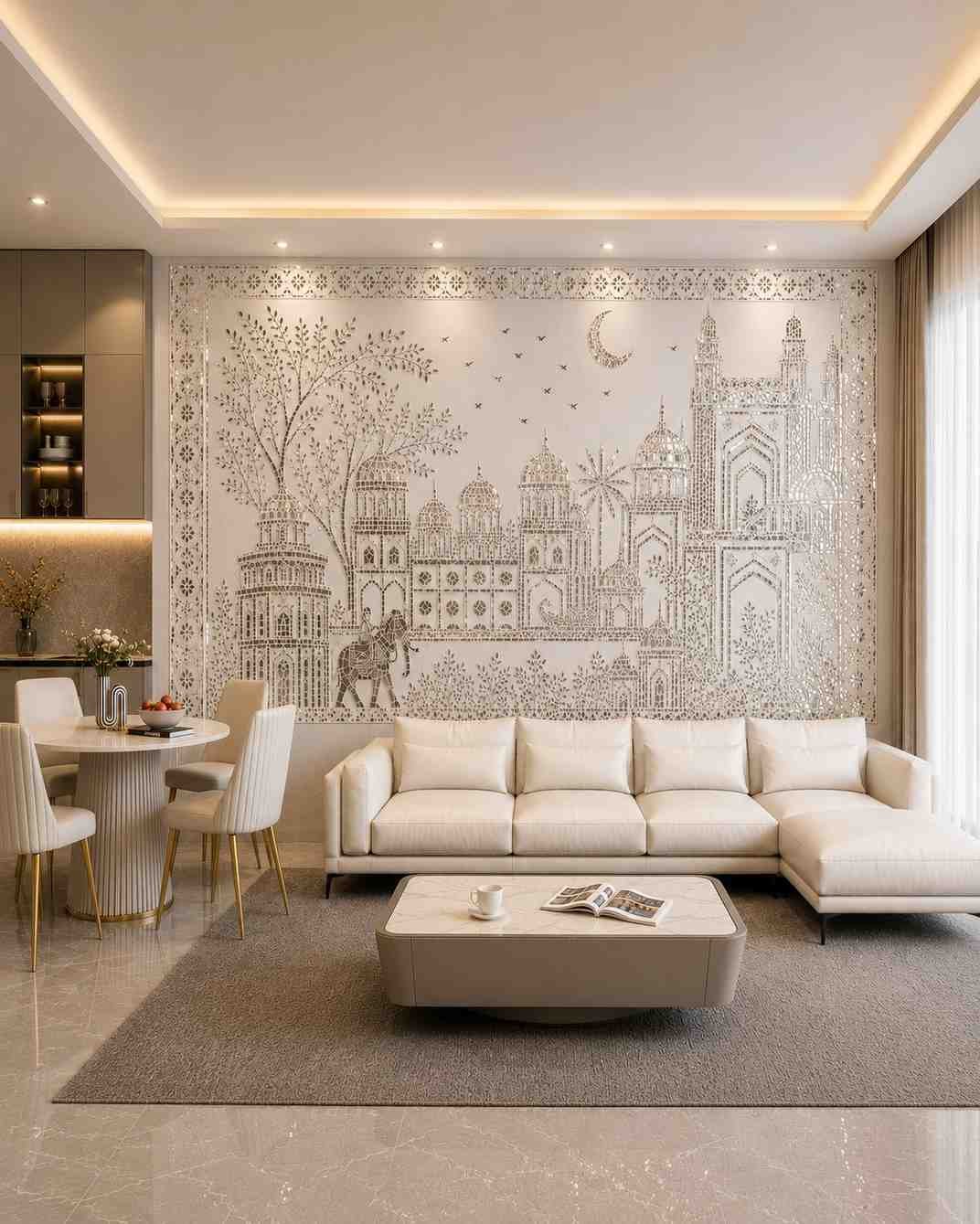
A smaller Thikri panel in a contemporary dining space can completely change the atmosphere.
A mirror installation in an entrance can catch the morning light.
A decorative panel can turn an otherwise quiet wall into something memorable.
It doesn’t have to recreate a Sheesh Mahal.
It simply needs to bring a little of that craftsmanship into the space.
The same thing happened with traditional paintings
I used to think traditional Indian paintings needed traditional frames, traditional furniture, and traditional surroundings.
Now I think the opposite can be more interesting.
Put an intricate traditional artwork in a very simple frame.
Hang it above a contemporary console.
Keep the wall quiet.
Let the artwork carry the visual weight.
The contrast makes you notice both things.
The modern furniture suddenly looks more considered.
The traditional artwork suddenly feels surprisingly contemporary.
And that’s something I find fascinating about Indian craftsmanship.
The technique may be centuries old, but the way we experience it doesn’t have to be.
I also became more comfortable with imperfection
This might be the most important lesson.
When you buy something manufactured in large quantities, you expect every piece to look exactly like the next one.
With handmade objects, that’s not always the case.
One brushstroke may be slightly different.
A natural wood surface may have a variation in grain.
A carved motif may have tiny differences.
A handmade textile may not have the absolute uniformity of a machine-produced one.
I used to see those things as imperfections.
Now, I often see them as evidence.
Evidence that someone actually made the object.
Someone sat down.
Someone chose the material.
Someone worked on the detail.
Someone decided when it was finished.
That makes the object feel different.
It has a maker.
I’ve also realised that you don’t need many handcrafted pieces
This is something I would tell anyone starting out.
Don’t try to turn your home into a craft exhibition.
You don’t need a traditional painting in every room.
You don’t need carved furniture everywhere.
You don’t need every surface decorated with something handmade.
Start with one piece.
Choose something you genuinely love.
Give it space.
Live with it.
See how it changes the room.
Then, if you find yourself wanting more, add another piece.
Over time, the home develops its own language.
And that’s much more interesting than buying everything at once.
The home becomes more personal when the objects have stories
That’s ultimately what changed my perspective.
I stopped asking:
“Will this look traditional?”
And started asking:
“Will this mean something to me?”
A carved wooden cabinet made by an artisan has a story behind it.
A Pattachitra painting has a tradition behind it.
A piece of Thikri has a technique behind it.
A handwoven textile carries the knowledge of the people who made it.
Once you know those stories, the objects feel different.
You’re no longer simply decorating a room.
You’re choosing what kind of stories you want your home to tell.
And maybe that’s where traditional Indian craftsmanship belongs in a modern home.
Not as a reminder of the past.
Not as something that needs to be displayed like a museum piece.
But as something that can be used, lived with, appreciated, and eventually passed on.
Because a modern home doesn’t need to forget where we came from.
Sometimes, all it needs is one beautiful reminder.