
India’s high-end decorative craft is concentrated in identifiable centres, most of them specialised for centuries: woodcarving in Saharanpur and Jodhpur, marble inlay in Agra, thikri mirror work and blue pottery in Jaipur, lacquered turning in Channapatna, Pattachitra and palm-leaf engraving in Raghurajpur, bidri in Bidar, brass in Moradabad. Knowing which town does what is the fastest way to tell a sourced piece from a styled one.
For about fifty years, “luxury” in an Indian home meant something that had arrived.
Italian marble. A German kitchen. French crystal in a cabinet that had itself been imported. The status of an object was substantially a function of the distance it had travelled, and the domestic equivalent — however well made — occupied a lower category by definition.
Something has changed, and it is easier to observe than to explain. Collectors who once bought European antiques now commission carved work in Jodhpur. Hotels that once specified imported joinery now specify Indian. And, quietly and more significantly, workshops that spent three decades supplying export markets anonymously have started selling domestically under their own names.
That last shift is the real one. The craft did not appear. It was always here, making things that were shipped elsewhere and sold under someone else’s label. What changed is the direction of the trade and the attribution.
This is a map of it. Where the work is actually made, what each centre is genuinely good at, and how to tell whether a piece came from that supply chain or is merely referencing it.
The craft map
| Centre | State | Specialism | Materials | Notes |
|---|---|---|---|---|
| Saharanpur | Uttar Pradesh | Wood carving, especially deep relief and jaali | Sheesham, mango | The largest concentration of carving labour in North India; supplies much of the country’s carved furniture trade |
| Jodhpur | Rajasthan | Furniture making, colonial and industrial revival forms, carved and painted work | Sheesham, mango, reclaimed timber, iron | India’s dominant furniture export cluster |
| Jaipur | Rajasthan | Thikri mirror work, blue pottery, gemstone setting, hand block printing (Sanganer, Bagru), carving | Mirror glass, lime plaster, quartz frit, timber, cotton | The broadest craft base of any Indian city; also the centre for stone carving |
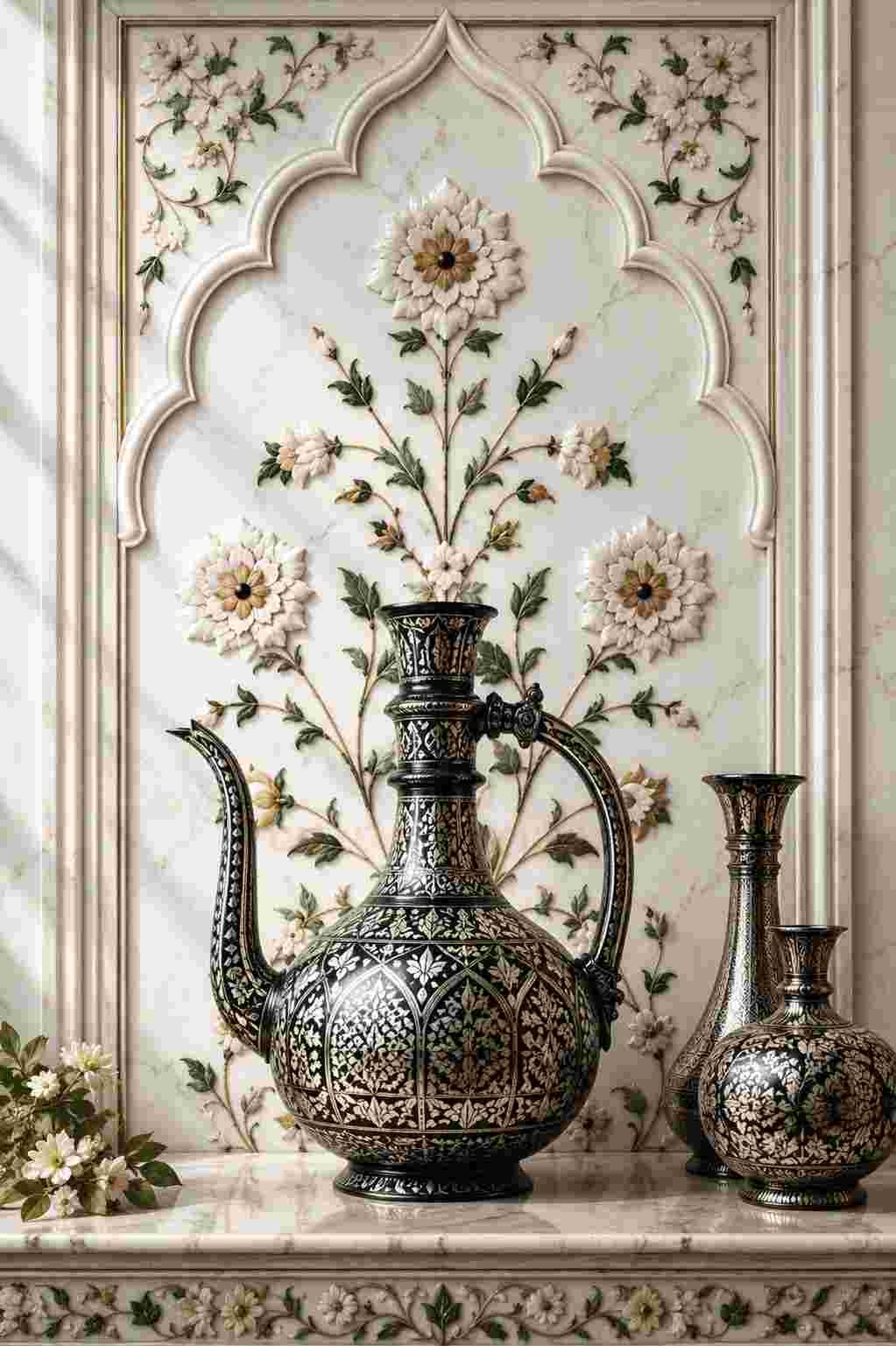
| Agra | Uttar Pradesh | Marble inlay (parchin kari) | Makrana and other marble, semi-precious stone | Direct descendant of the Mughal imperial workshops |
| Channapatna | Karnataka | Lacquered wood turning | Wrightia tinctoria (ivory wood / aale mara), vegetable dyes | GI-protected. Traditionally patronised by Tipu Sultan; roughly 254 artisans in home units and 50 in small factories as of a 2011 count |
| Raghurajpur | Odisha | Pattachitra painting, palm-leaf engraving (tala pattachitra) | Palm leaf, cloth, natural pigment | A designated heritage craft village; almost every household practises the craft |
| Bidar | Karnataka | Bidriware — zinc alloy inlaid with silver, blackened | Zinc-copper alloy, silver | GI-protected. A single-town craft with no equivalent elsewhere |
| Moradabad | Uttar Pradesh | Brass work, metal casting and finishing | Brass, other metals | India’s principal brass cluster, largely export-oriented |
| Kutch | Gujarat | Embroidery (many distinct community traditions), bandhani, Rogan art, lacquer turning | Cotton, silk, mirror, wood | Not one tradition but a dozen, differentiated by community |
| Kanchipuram | Tamil Nadu | Kanjeevaram silk weaving | Mulberry silk, zari | GI-protected. The korvai border technique interlocks separately warped border and body by hand |
| Varanasi | Uttar Pradesh | Banarasi brocade weaving | Silk, zari | GI-protected |
| Bhuj / Ajrakhpur | Gujarat | Ajrakh block printing | Cotton, natural dyes | Resist printing with a multi-stage process |
| Srinagar | Jammu & Kashmir | Pashmina, kani weaving, walnut wood carving, papier-mâché | Pashmina wool, walnut, paper | Walnut carving is a distinct and under-recognised furniture tradition |
| Thanjavur | Tamil Nadu | Tanjore painting, bronze casting (nearby Swamimalai) | Gold foil, gesso, bronze | Swamimalai bronze casting uses the lost-wax method continuously since the Chola period |
| Firozabad | Uttar Pradesh | Glass | Glass | India’s glass cluster |
| Bhadohi / Mirzapur | Uttar Pradesh | Hand-knotted carpets | Wool, silk | India’s carpet belt |
What “made in India” actually has to mean
The map above is only useful if you can check a claim against it, so here is what to ask.
Ask for the town, not the country. “Made in India” is a customs classification. “Carved in Saharanpur, assembled in Jodhpur” is a supply chain. Any seller working with real workshops can give you the second answer; most will give you the first because it is all they have.
Ask whether the workshop is named. There is a meaningful difference between a brand that buys from a trading agent who buys from workshops, and one that has a relationship with a specific workshop. Neither is dishonest. Only one can tell you who made your table.
Check whether the specialism matches the place. This is the map’s most practical use. Marble inlay from Agra is a coherent claim. Thikri from Jaipur is coherent. Bidri from anywhere other than Bidar deserves a question. “Channapatna-style” is not Channapatna.
Ask about GI status where it applies. Channapatna toys, Kanjeevaram silk, Banarasi brocade, Bidriware and many others carry Geographical Indication protection. A GI is a legal fact you can verify, not a marketing claim.
Ask what the artisans are paid, and how. The 2026 Institute for Human Development and Crafts Council of India study found average earnings across India’s handicraft and handloom sector of about ₹270 a day — below the statutory minimum wage in every state surveyed. A supply chain you cannot see is a supply chain you cannot vouch for.
What actually changed
Four things, none of them aesthetic.
1. The export workshops became visible. For decades, Jodhpur and Moradabad and Bhadohi produced for foreign buyers under foreign labels. The domestic market was smaller and paid less. As Indian disposable income rose, selling at home under your own name became viable — and the manufacturing capacity was already there, fully formed.
2. Attribution became a selling point. A generation of buyers wants to know who made the thing. That is a genuine shift in what “luxury” signifies: from distance travelled to provenance known. It is also the shift that makes craft economically legible again, because an anonymous maker cannot command a premium.
3. The GI regime gave places legal standing. Geographical Indication registration turned “this is from Channapatna” from an assertion into a protected claim. That matters commercially and it matters for what a place can charge.
4. Architects and designers started specifying Indian. The single most consequential change, and the least visible to consumers. When a hotel or a residential project specifies Indian carved work rather than imported joinery, it moves volume that no direct-to-consumer brand can match.
What has not changed, and should be said
The optimism above needs a floor under it.
The wages have not moved. The ₹270 daily average is the central fact of this sector and it is not improved by any of the four shifts above. Visibility is not the same as income. A craft can become fashionable and its practitioners can stay poor, and in several of these centres that is precisely what has happened.
The transmission is fragile. Channapatna’s count of roughly 254 artisans in home units, in a town of over 70,000, is a small number for a GI-protected craft with national recognition. Several of the traditions on that map are being carried by a few hundred people, some by a few dozen.
Volume pressure degrades craft. When demand rises faster than skilled labour, the response is shortcuts — machine-roughed carving sold as handwork, chemical dyes sold as vegetable, thinner inlay, fewer finishing passes. This is happening now, in most of these centres, and it is the main threat to the category’s credibility.
“Indian luxury” can become its own kind of import. A Rajasthani motif executed in Vietnam, or a Channapatna form turned in a factory in another state, is the same substitution the trade has always made. The map is useful precisely because it lets you check.
How to buy from this map
A practical sequence.
- Decide what craft you actually want, not what look. “Carved wood” and “marble inlay” are different supply chains with different economics and different failure modes.
- Find the centre on the map. If a seller’s claimed origin does not match the specialism of the place, ask why.
- Ask for the workshop. A name, a town, ideally a person. Compare the answer with our ten showroom tests for hand-carved work.
- Check GI status where the craft has one.
- Ask about the makers’ pay basis — day rate, piece rate or salaried.
- Ask what happens when it needs repair, and who does it.
A seller who answers all six is not necessarily the cheapest. They are accountable, which over a twenty-year object is worth more.
The Folklorei view
Folklorei works across several of the centres on this map, and the people we work with are named on this site rather than described in the abstract — Wasim Ahmad carving in Jaipur, Hemraj Kumawat cutting thikri mirror, Nibedita Swain engraving palm leaf in Raghurajpur, Mukunda Chandra Mohanty painting Pattachitra in Balang.
But the argument of this article is not about any one studio, and it should not be. A category map is more useful than a brochure, and more persuasive — because the honest version of “Indian luxury is made here” includes the workshops that are not ours, the traditions we do not work in, and the wage problem none of us has solved.
The shipping has reversed. That is a genuinely significant thing and it happened without much announcement. What determines whether it lasts is not whether Indian buyers keep finding Indian craft desirable. It is whether the people making it can afford to keep doing it, and whether their children can afford to learn.
Those are answerable questions. They just require someone to publish the numbers.
Frequently asked questions
Where is handcrafted furniture made in India?
The major centres are Jodhpur in Rajasthan, which dominates furniture export, and Saharanpur in Uttar Pradesh, which holds the largest concentration of carving labour in North India. Jaipur is a broader craft base covering carving, thikri mirror work, stone and block printing. Srinagar has a distinct walnut-wood carving tradition that is often overlooked.
What craft is Channapatna known for?
Lacquered wood turning — toys, dolls and turned objects made from Wrightia tinctoria, locally called aale mara or ivory wood, coloured with vegetable dyes. The craft is Geographical Indication protected and was historically patronised by Tipu Sultan of Mysore. It is based in Ramanagara district, Karnataka.
What is bidriware?
A metal craft from Bidar in Karnataka, in which a zinc-copper alloy is inlaid with silver and then chemically blackened so the silver stands out against a matt black ground. It is Geographical Indication protected and is effectively a single-town craft with no direct equivalent elsewhere in India.
What is parchin kari?
Parchin kari is the Mughal marble inlay technique in which shaped pieces of semi-precious stone are set into carved recesses in marble. It is centred on Agra and descends directly from the imperial workshops that produced the Taj Mahal’s floral inlay.
How can I tell if Indian furniture is genuinely handmade?
Compare two elements that should be identical — hand carving produces similar but never identical repeats. Look into the deepest recesses for a sharp intersection rather than the radius a rotating cutter leaves. Check whether you can slide a fingernail behind an undercut. Then ask the seller which town it was carved in and whether they can name the workshop.
What is a GI tag and does it matter?
A Geographical Indication is a legal registration that ties a product name to a place of origin, protecting it from use by producers elsewhere. Channapatna toys, Kanjeevaram silk, Banarasi brocade and Bidriware all carry one. It matters because it is a verifiable legal fact rather than a marketing claim.
Is Indian craft actually sustainable?
It varies enormously by craft and by workshop. Some inputs have genuinely good sustainability profiles — mango timber is typically harvested from plantations at the end of fruit-bearing life, making it an agricultural by-product. But the sector’s central problem is economic rather than environmental: average earnings of about ₹270 a day, below minimum wage in every state surveyed in 2026, is not a sustainable basis for transmitting a craft to the next generation.
Why did Indian luxury used to mean imported goods?
Largely because the domestic market paid less than export markets did, so India’s best workshops produced anonymously for foreign labels while status at home attached to objects that had travelled. As domestic incomes rose and provenance became a selling point, those same workshops began selling under their own names.