There is something different about a piece of furniture made by hand.
You notice it before you can always explain why.
Perhaps it is the way the wood grain moves across the surface. Maybe it is a tiny variation in a carving, the softness of a hand-finished edge, or the way a piece seems to have a character of its own.
Now place that piece beside a mass-produced version.
At first glance, they may look similar. Both may serve the same purpose. Both may have polished surfaces, carefully measured dimensions, and attractive designs.
But they are made with very different intentions.
Mass-produced furniture is designed to be replicated. Handcrafted furniture is created to be experienced.
That difference begins long before the finished piece enters your home.
What is handcrafted furniture?
Handcrafted furniture is furniture made substantially through the skill and intervention of an artisan or craftsman, rather than being produced entirely through automated, high-volume manufacturing.
That doesn’t mean every handcrafted piece is made without modern tools. Skilled artisans may use machines for certain stages of cutting, shaping, sanding, or preparation.
What makes the difference is the human judgment involved in the making.
An artisan decides how to work with the natural character of the material. They make adjustments during the process. They refine details by hand. They decide when a surface is finished and when it needs another layer of attention.
The result is furniture where the making itself becomes part of the object.
And that is something worth understanding before choosing furniture for your home.
1. Every piece begins with the material
One of the most beautiful things about handcrafted wooden furniture is that no two pieces of natural wood are exactly alike.
Wood has its own grain, knots, colour variations, texture, and character.
A mass-production process often works around these variables to create consistency. The objective is usually straightforward: make thousands of pieces that look as similar as possible.
An artisan approaches the material differently.
The grain can influence the direction of a carved detail. The natural character of the wood can become part of the design. A craftsman may choose one section of timber for a particular component because of the way it looks or behaves.
Instead of asking the material to conform completely to the product, the maker learns to work with it.
That relationship between material and maker is one of the defining qualities of handcrafted furniture.
2. The human hand changes the way a piece looks
Look closely at traditional carved furniture and you may notice something subtle.
The pattern is precise, but it doesn’t always feel mechanically identical.
That is not a flaw.
It is evidence of the process.
Hand carving, hand painting, hand polishing, hand finishing and traditional decorative techniques leave behind small variations that make each piece individual.
A machine can reproduce the same pattern thousands of times.
A human hand introduces something different: judgement.
An artisan knows when a line needs to be deeper, when a curve needs to be softened, when a surface needs more finishing, or when a particular detail is better left slightly understated.
These decisions may be almost invisible to someone seeing the finished furniture for the first time.
But together, they create character.
3. Handcrafted furniture takes time—and time becomes part of the value
Modern manufacturing has made furniture more accessible, faster to produce, and easier to distribute.
That has its place.
But handcrafted furniture operates on a different relationship with time.
A carved panel cannot always be rushed.
A detailed surface may require repeated stages of shaping and finishing.
A traditional decorative technique may involve processes that have been refined over generations.
The time involved isn’t simply labour added to a price tag.
It is part of what you’re receiving.
When you buy a handcrafted piece, you’re not only buying the finished object. You’re also receiving the accumulated knowledge of the person who knows how to make it.
Years of practice are condensed into every cut, curve, joint, brushstroke, and finish.
4. Custom furniture can be designed around your space
Another important difference is the possibility of customisation.
Mass-produced furniture generally begins with predetermined dimensions and designs. You choose from what is available.
With handcrafted furniture, the conversation can begin differently.
What is the size of the room?
Where will the furniture sit?
What materials already exist in the space?
What kind of atmosphere do you want to create?
Do you want a traditional carved detail or something more understated?
A skilled artisan or furniture designer can use these requirements to develop a piece specifically for its intended environment.
This is particularly valuable in interior design, where proportions matter.
A beautiful piece of furniture can still feel wrong if its scale doesn’t suit the room.
Handcrafted furniture offers the possibility of creating something that belongs to the space rather than simply occupying it.
5. Small variations are part of the beauty
One of the biggest misconceptions about handmade products is that variation means inconsistency.
It doesn’t always.
When you’re buying factory-made furniture, you generally expect one product to look exactly like another.
With handmade furniture, subtle differences are often inevitable—and desirable.
The shade of natural wood may vary.
A carved motif may have tiny differences.
A hand-painted element may carry its own brushwork.
A natural material may have markings that weren’t visible in another piece.
These details tell you something important:
This wasn’t simply copied. Someone made it.
For many people, that is precisely what makes handcrafted furniture special.
6. Traditional craftsmanship carries cultural knowledge
Furniture can also carry something that goes beyond design.
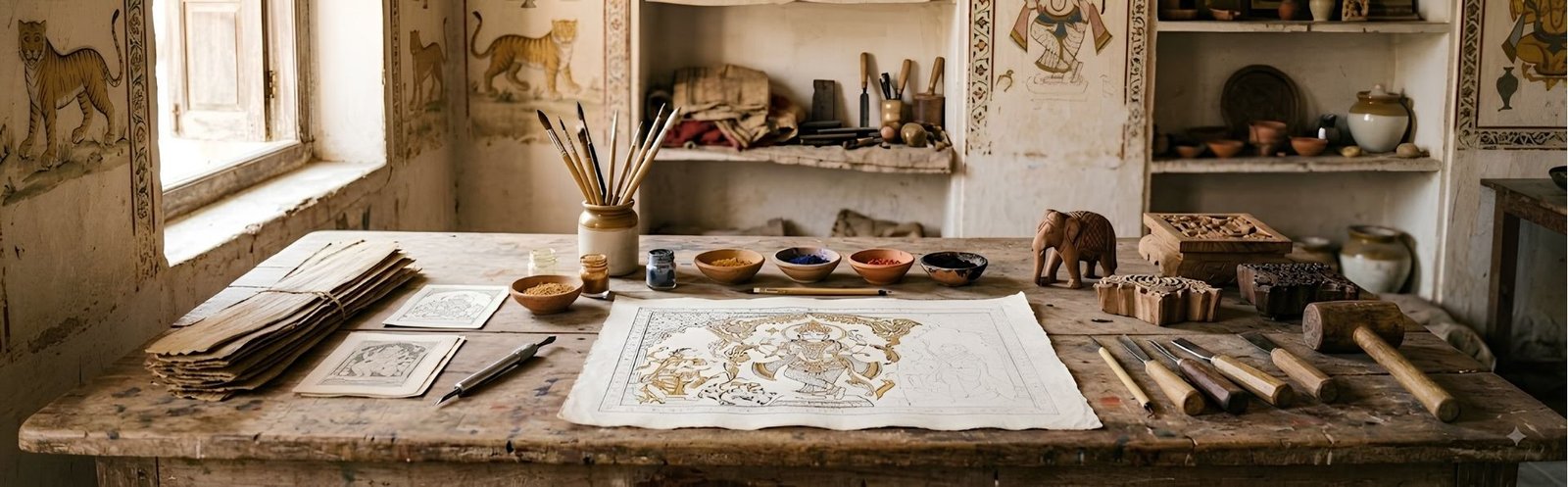
Across India, generations of artisans have developed specialised knowledge around materials, decorative techniques, carving, painting, joinery, weaving, metalwork and other forms of craftsmanship.
These skills are often closely connected to particular regions and communities.
A carved wooden piece from Rajasthan can carry a visual language very different from a traditional craft from Odisha.
A handcrafted object made using an old technique isn’t simply decorative. It can represent knowledge that has travelled through generations.
When such work finds a place in a contemporary home, something interesting happens.
Heritage meets everyday life.
A traditional technique no longer exists only in historical buildings or museums. It becomes part of a living interior.
7. Handcrafted furniture develops character over time
Perhaps the biggest difference becomes visible years after you buy the furniture.
A mass-produced piece may remain almost exactly as it was when you bought it.
A well-made handcrafted piece can change.
Natural wood can develop a deeper patina. Small marks become reminders of use. Surfaces acquire the character of everyday life.
The dining table where family celebrations happen.
The cabinet that holds photographs and keepsakes.
The chair that becomes someone’s favourite place to sit.
Over time, furniture can stop being simply furniture.
It becomes part of the home.
That is why a beautifully made handcrafted piece has the potential to become an heirloom—something that can be repaired, cared for, and passed forward rather than simply replaced when a trend changes.
Is handcrafted furniture better than mass-produced furniture?
Not necessarily in every situation.
Mass-produced furniture has its advantages. It can be affordable, readily available, consistent, and practical for many needs.
The question isn’t whether one is universally “better.”
The better question is:
What do you want your furniture to mean to you?
If you need something quickly and economically for a temporary space, mass-produced furniture may make perfect sense.
But if you’re looking for a piece with individuality, craftsmanship, customisation, natural materials, and a sense of permanence, handcrafted furniture offers something different.
You’re choosing the story behind the object as much as the object itself.
How to recognise genuinely handcrafted furniture
The word handcrafted is used widely today, so it is worth looking beyond the label.
Ask questions.
Who made it?
A credible artisan-made product should have a maker, workshop, studio, or craft tradition behind it.
How was it made?
Look for information about materials, techniques, finishing, carving, painting, or construction.
Where did the craft originate?
Traditional Indian crafts are often closely connected to particular regions and communities.
Are natural variations expected?
A genuine handmade piece may not look perfectly identical to another piece—and that can be part of its authenticity.
Can the maker explain the process?
The more transparent the story behind a piece, the easier it is to understand its value.
Because ultimately, craftsmanship should never need to hide behind a label.
It should be visible in the work.
The value of something made slowly
We live in a world built around speed.
Faster production.
Faster delivery.
Faster trends.
But our homes don’t have to follow the same pace.
There is something deeply satisfying about bringing an object into your home that was made slowly, thoughtfully, and with skill.
A handcrafted table isn’t simply a surface.
A carved cabinet isn’t simply storage.
A hand-finished chair isn’t simply somewhere to sit.
Each one represents materials, decisions, techniques, time, and human hands coming together to create something that didn’t exist before.
That is the real difference between handcrafted and mass-produced furniture.
One is made to be replicated.
The other is made to be remembered.
And perhaps that is why the most meaningful pieces in a home are rarely the ones we replace with the changing seasons.
They are the ones we keep.
The ones that gather stories.
The ones that eventually become part of ours.
At Folklorei, we believe the value of a handcrafted piece begins long before it reaches your home. It begins with the artisan, the material, the technique, and the generations of knowledge behind it.
Explore handcrafted treasures created with that philosophy →